Will World War 3 ever happen? How will the next major global conflict break out? The Editorial Board of PST has been keeping track of global flashpoints. A global flashpoint is an area or dispute that has the potential to escalate into widespread international conflict.
Listed are some of the world’s most most volatile global flashpoints. Each of the flashpoints was selected due to its volatility and to potential to drag the world’s superpower into the next world war. Let’s take a closer look…
Syria
_-_SYR_-_UNOCHA.svg)
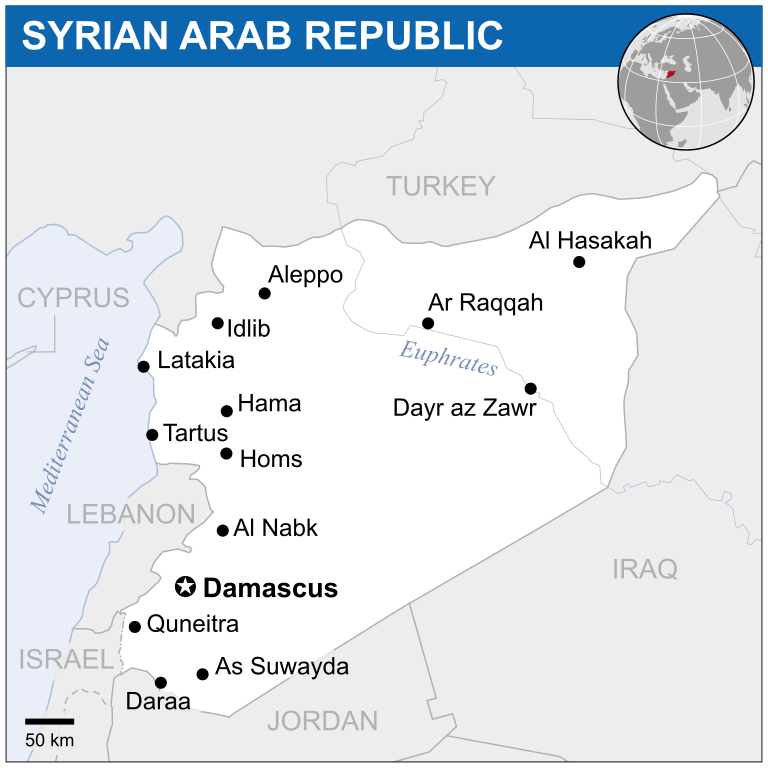
The good guys ain’t taking things sitting down. In April 2018, US President Donald Trump ordered airstrikes at chemical weapons plants in Syria. The airstrikes were strongly supported by U.K and France, the United State’s top allies and staunchest defenders of democracy. This is likely to escalate conflict in the region as the regional and world superpowers fling in more firepower into the region.
What makes this conflict dangerous is it is forcing the lines between the lines of allegiance to be drawn an ever brighter red. One side is led by Russia, and its allies are Iran, China, Lebanon and other countries in their sphere of influence. The other side is led by the US, and its allies are UK, France, Germany, Canada, Israel, Turkey and the other countries in their sphere of influence.
South China Sea
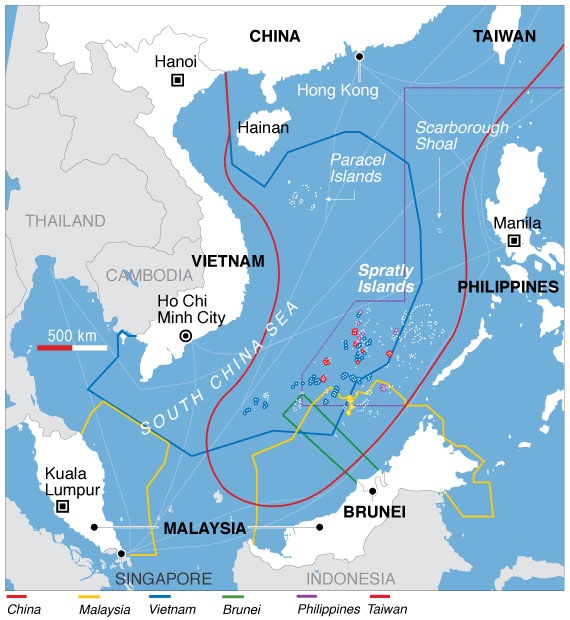
The South China Sea is rich in natural gas and has one of the world’s most important fisheries. It is no surprise that China flexing is muscles over the region, driving out other claimant countries from the region with military harassment. Adding fuel to the fire is China’s drive to shake of its reliance on “dirty” coal in favor of cleaner energy sources like natural gas. Of course, with such astoundingly rich undersea deposits of natural gas, the Communist Party is bend on asserting control and sovereignty over the region.
There’s another reason that may ultimately be a more important than natural gas and fish why this region is so sensitive. One third of the world’s shipping passes through the South China Sea. Whoever militarily controls this region theoretically can control this trade.
The gist of the matter is that China claims the almost the entire South China Sea. The have crude lines drawn on Communist-Era maps without any proper geographic coordinates. The the “9-dash line” or “cow’s tongue”. Of course, these arbitrary lines are not recognized by international law, particularly the United National Convention on the Law of the Seas (UNCLOS).
These illegal “sea grabbing” is bad news for countries like the Philippines, Vietnam, Burnei and practically all other coastal states. China is trying the old “divide and conquer”, trying to break up the opinions of the ASEAN bloc (Association of South East Asian Nations). This is something China is successfully doing because of two main factor. 1) ASEAN’s penchant to only reach agreements on consensus of all it member state. 2) China is winning over the governments of cash-strapped Cambodia and Laos with its “investment diplomacy”. The combination of the two has left the door wide open for China in the South China Sea.
Despite the Philippines, the main claimant and the most affected country, winning hands-down a case it filed against China at a UN international court at the Hague in July 2016, China is asserting its power. Against international law, China has build several artificial islands with military installations. China’s military leaders openly talk about their “cabbage strategy” where they simply swarm and overwhelm at territory with different layers of civilian, paramilitary and military elements to take over the South China Sea. And, their strategy is working.
China through its massive clout and growing influence can by carrot and stick take over the seas of the smaller states of the ASEAN. However, larger countries may not be so easily bullied. The United States and naturally-alarmed Australia have conducted Freedom of Navigation Operations in the area – the sailing of military vessels within the contested region.
There is no way the United States and its allies will allow China to impede navigation in the South China Sea. There is no way China will allow their imagined “sovereignty” in the region to be challenged. With such a tinderbox of dangerous elements, this global flashpoint can easily spark a global confrontation between China and United States.
Doklam, Aksai Chin and Arunachal Pradesh (Indian-Chinese Border)
India and China are two of world’s most populous countries, with populations of 1.2 billion and 1.3 billion respectively. One is the world largest authoritarian country. The other is the world’s largest democratic state. The prospect of these two behemoths clashing is truly frightening. What is surprising is that they may clash over a remote region in the Himalayas.
In mountainous border between India and China have long been a source of conflict between the two. In June 2017, Chinese forces started building a road in an area with the tiny Kingdom Bhutan. India, a country that has formal relations with Bhutan as its military protector, came to Bhutan’s aid to stop the construction. The road being build was of high grade, enough to carry the heaviest of China’s tank. This was quite suspicious for such a remote region. In this conflict the Chinese side was caught red-handed lying that Bhutan did not dispute the territorial claim, much to the ire of India and Bhutan. While, through diplomatic intervention the situation is at a standstill, at any time, this can change.
It is not talked about widely in world history classes but war between India and China has happened before. In 1962, China invaded India for granting asylum to the Dalai Lama and its opposition to China’s occupation of Tibet. Back then in the 60’s, both countries struggled with their own economic problems and the news of their war hardly entered the consciousness of the public in the West. In fact, at the time India could only muster around 14,000 soldiers to the front.
This has changed massively since then. India and China are now the world’s largest economies, 2nd and 7th respectively. India has 1.13 million soldiers in active duty with 21 million in reserve. Meanwhile, China has 2.3 million soldiers on active duty with 2.3 million in reserve. Both have among the world’s most advanced militaries. Both are armed with nuclear weapons. This time, if war breaks out, it will be earth-shaking.
The border conflict over this remote region is just spark over a lot of deep-seated issues. Locally, there is the issue of the Tsangpo–Brahmaputra River. Both India and China want to tap it for water and hydroelectric power. The shared growing thirst for water and energy will drive these two countries into closer to conflict. In 2016, China blocked India’s membership in the international “Nuclear Suppliers Group”. This prevents larger Indian involvement in the exchange of nuclear material and technology. This left India with a black eye. On a strategic level, India has also firmly rejected China’s “One Belt, One Road” economic plans. Both behemoths are bound to clash in their struggle for dominance.
China can be pushed or drawn into a war because of one of its allies – Pakistan. Ever since Pakistan was carved out of Indian territory, it has been long embroiled in conflict with India. India and Pakistan are no strangers to military conflict with each other, with the heavily contested Kashmir region at the center of conflict.
Kashmir (Pakistan-Indian Border)

Since Pakistan was partitioned from India in 1947, the two countries have experienced four wars and several military conflicts all most all directly or indirectly linked to the Kashmir region.
The mountainous region Kashmir is the northernmost region of the Indian subcontinent. Historians point root of the conflict in the region as beginning in the partition of Pakistan from India in 1947. As British India was being divided, Kashmir has the choice of joining either Hindu-majority India or Muslim-majority Pakistan or remaining independent. The ruler of Kashmir, Maharaja Hari Singh, was Hindu while most of Kashmir’s people were Muslim. Caught between Muslim Pakistan and Hindu India, the ruler decided to stay independent. In response Pakistan supported Muslim tribesmen and insurgents to try take Kashmir by force.
The Kashmir’s Hindu ruler fled to India and appealed to the Indian government for military assistance. Doing so, he ceding Kashmir to India.
The threat of nuclear conflict between India and Pakistan is often brought up by military experts. Both countries are locked in a nuclear arms race. Pakistan has stated it has a “first strike policy”, meaning it would use its nuclear weapons if and only if, the Pakistan Armed Forces are unable to halt an invasion or a nuclear strike is launched against Pakistan. Meanwhile, India has a declared policy of “no first use”.
China and India both follow a “no first use” nuclear weapons doctrine. Pakistan has a “first strike policy”. This volatile brew makes Kashmir one of the world’s most dangerous global flashpoints.
North Korea
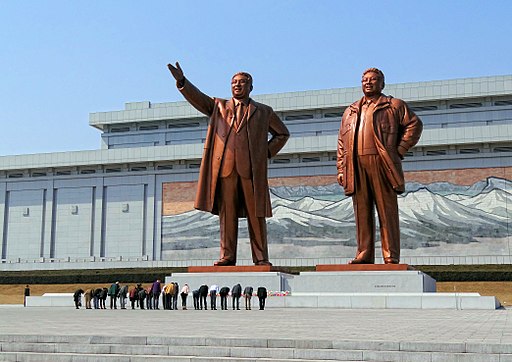
Update (4/29/2017): It looks like there will be significant de-escalation of the region. North Korean Leader Kim Jong Un and South Korean President Moon Jae-in met and shook hands right at the border between the two Korea. This took place at the Inter-Korean Summit on April 27, 2018 and was hailed around the world as the start of the end of the long uneasy war between the two. The message is clear. The North Korean leader wants Korea reunited. But let’s keep North Korea here on this article. We don’t know what’s coming up.
No article on global flashpoints would be complete without North Korea. North Korea contains all the elements of the next war. It seems like a perfect recipe.
- A mad dictator with a cult following and absolute power
- Nuclear weapons
- Hackers
- The backing of China… And the US backing of South Korea.
- Distrust and animosity towards the United States
- An impoverished population that is only falling farther behind the rest of the world.
After all, the “Dear Leader” is so fond of threatening to nuke a major US City. With him wielding absolute power over his subjects, he might just follow through with this threats one day. And when this happens, it could trigger a chain of events that could drag China and the US into war.
Even if let’s say, North Korea, just implodes upon itself through civil uprising or its government just collapses. Or maybe it does launch a nuclear missile against the US but even it’s bigger brother China disowns the erratic hermit state. If such happens, the United States or South Korea will probably overrun the North Korea in a matter of weeks. But this will not be the end of the story.
If North Korea and South Korea simply become Korea (obviously ruled from Seoul), this will become a festering wound in the side of China. North Korea has for decades played the role between the democracy-loving South Koreans and the subjects of authoritarian Communist Chinese rule. Sharing a border will unleash a deep reaching tensions between the two.
With all these volatile element boiling in the North Korean pressure cooker, it’s bound to explode one day.
Palestine
The Jewish state of Israel, was declared on 14 May 1948, right after World War II. The very next day, the armies of the neighboring Arab states invaded Israel, just formerly under British protection. While Israel, was able to fend of the forces of Egypt, Syria, Lebanon, Iraq, Palestinian militia and other Arab countries in that war, Palestine has since been the center of conflict in the region.
Palestine is a de jure sovereign state. That means it is a country that is legally (de jure) recognized by other countries but does not have the actual control over its claimed territory. The flip side of a de jure state would be a country that has de facto or actual control over the area. The de jure state of Palestine claims the West Bank and Gaza Strip with East Jerusalem, all of them under the de facto control of Israel.
Palestine is an Islamic country. Meanwhile, Israel is a Jewish country. The claims of Palestine are backed by Arab countries. Meanwhile, Israel is supported by the United States. On the surface it seems that this is a conflict of religion, Islam versus Judaism. Peeling of religion, it is a conflict of who has control of the territory Palestine claims.
A solution of course would be to partition Israel and carve out some territory for the Palestine. This is sometimes referred to a “two-state solution”. However, Israel understandably will never allow this solution.
Part of Israel’s unmovable attitude towards maintaining absolute control over their territory is a Jewish belief called “Zionism”. This basically means Israel is to the Jewish people is their “promised land”. The same way Chinese deserve China and the French deserve France, Zionists believe the Jews deserve Israel.
On the other side of the conflict is a “one-state solution”. Palestine could give up its claim and submit to Israeli control. The Arab leaders will never allow it. Of course the leadership of Palestine will cling on to power at all cost. If it were up to some radical elements in the Arab world, the “one-state solution” could be the other way around. Israel could be ‘wiped of the place of the earth’ and replaced with a Palestinian state. This threat has been repeated by many radical Arab leaders, and continues to cause tension in the region.
For the past decades, US-backed Israel has managed to keep tight control over its territory and keep Palestinian separatists and terrorists in check. This might not always be the case though, and at any time, events can spiral into war.
Imagine radical elements in a fundamentalist country like Iran or Syria invading or supporting elements that Israel so international retaliation is necessary. A Russian-backed Iranian or Syrian government could imaginably be bold in trying to destabilize Israel and liberate Palestine. Truly, Palestine remain one of the world’s most dangerous global flashpoints.
Cyberspace – Chinese hackers targeting US assets and organizations
A flash point usually refers to a contested geographic region. This global flashpoint is a little different compared to all the other global flashpoints listed here. This one is cyberspace. We’ll make an exception here because of the strong potential for it to develop into a full-fledged conflict between the United States and China because of Chinese cyber-espionage.
Some international relations experts have observed that what Chinese politicians and diplomats say may not always be in step with what their military actual does. Government-backed hackers have repeated hacked into US-held assets and organizations. One well-documented incident was the discovery of government-backed Chinese hackers attempting to infiltrate organizations behind the THAAD (Terminal High Altitude Area Defense) missile defence system in US-allied South Korea in April 2017.
It is well-known that the Chinese military maintain cyberwarefare armies that have time and again attacked Western countries.
Chinese hackers do not only attack military targets and organizations, but also economic targets. In May 2014, a Federal grand jury indicted five Chinese military officers for stealing confidential business information and intellectual property from US commercial firms and planting malware on their computers. This was done to gain advantage for Chinese government-owned corporations.
With so many high-technology assets like missile system, nuclear weapons, satellites and other military weapons and technologies that give the West economic advantages, it is easy to imagine a scenario where Chinese cyberespionage turns into full-fledged war. Cyberspace may be an evermore dangerous global flashpoint as these technologies become more important.
Can World War 3 Really Happen?
The last truly global conflict ended with World War II in 1945. It was said until the very last day before World War II many people believed another world war (World War I ended in 1918) could never happen. Still, world war came and engulfed the globe. The Cold War, which last right after World War II until the collapse of the Soviet Union in 1991. During the Cold War, there were many extremely close calls which potentially could have escalated to full nuclear war between the US-led and the Soviet-led blocs. The world might have just narrowly escaped another world war during the Cold War, but this goes to show that global flashpoints can still start a series of events that can escalate into a full-fledged world war.
PST believes that a full-fledged nuclear war will not directly cause a collapse of civilization. Predictions of nuclear winters resulting from a nuclear war have been regarded by scientists as improbable, especially with the modern nuclear weapons which have less nuclear power (but a lot more accuracy). However, a world war will definitely put other factors into action that will be more destructive to society. Perhaps, during a prolonged war, major world powers will not be able to cooperatively flight some other global threats, like global famine cause by environmental collapse. This is what makes these global flashpoints truly the world’s most dangerous.